
Look Again! – October Week 1
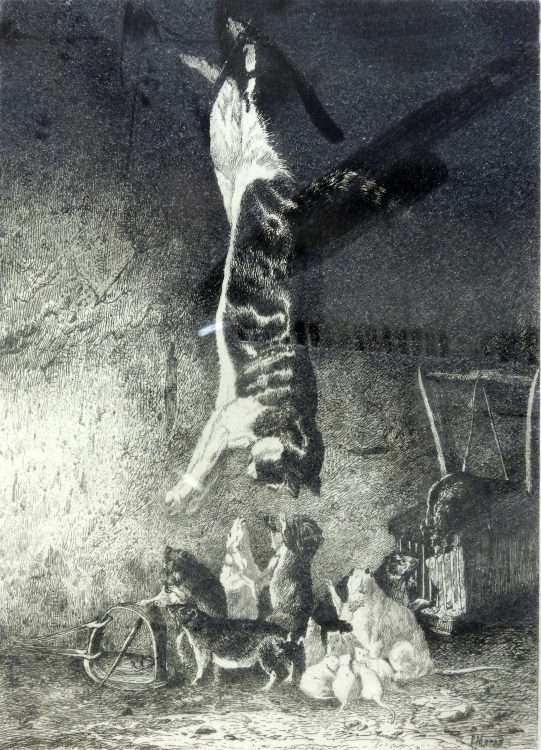
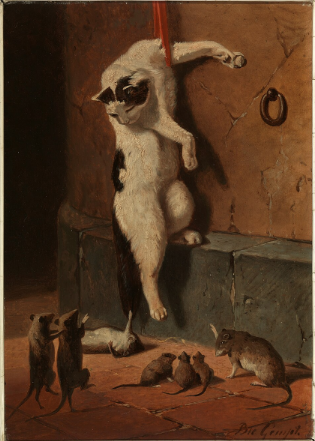
Week 1 – October 6, 2025: Peter Moran, The Cat Feigning Death & Bernard Te Gempt, Kat Met Muizen (Cat with Mice)
Peter Moran, The Cat Feigning Death, 1877, Etching, 8-3/4 “h x 6’ w
Bernard Te Gempt, Kat Met Muizen (Cat with Mice),1870, Oil on canvas
In the mid-nineteenth century, French artists began exploring the creative potential of etching, a medium previously used to reproduce paintings for publication. Spurred in part by their European counterparts, late nineteenth-century American artists began to explore the medium’s possibilities. Although etching had been in use for centuries, interest in it waned by 1800, alongside the invention of lithography and the developing popularity of reproductive engraving. Produced by sketching upon a malleable wax ground instead of carving into a copperplate, etching more closely resembled the practice of drawing and was seen as directly connected to the artist’s hand. Etchers were also often more involved in the printing of their works, and could select inks, papers, or processes themselves or in collaboration with a master printer. These qualities led etching to be viewed as more authentic, artistic, and expressive than engraving where artists aligned themselves with the notion of the “painter-printmaker”—a producer of specifically artistic prints, for whom printmaking was a means of formal exploration rather than entrepreneurial gain.
Completed in 1877, the etching The Cat Feigning Death, by Peter Moran, follows this tradition where he creatively reproduced a scene after a painting by Dutch artist Bernard Te Gempt. The scene also borrows from a story by French fabulist Jean de la Fontaine (1621-1695). Fables were a form of fictional folk literature that largely featured animals, and plants that were anthropomorphized to teach a moral lesson.
In this scene, rats move freely about under the scrutiny of a grey and white cat whose limp body hangs from a makeshift trapeze that Moran used to create a vertical line in the composition. Circus repertoires were all the rage during this time, and trapeze performances had become an integral part and were popular since the mid-nineteenth century. Moreover, Moran took creative license, as the cat in the original painting Kat Met Muizen (Cat with Mice),1870, by Te Gempt (1826-1879), is suspended only by her left arm, while her body finds support on a walled ledge. This work may suggest a much easier predatory pose in which the cat can jolt back to life in order to secure a rat for dinner. In both paintings, however, the rats and mice appear fooled and busy themselves about cautioning one another against at least two traps they are learning to avoid.
Cats have had a checkered past ranging from demonic characters, rat catchers, contemplative companions, and tricksters. Artists have unwittingly portrayed them as both feline friend and foe. The naturalism of the Renaissance and later styles of the Baroque rehabilitated the cat’s innate qualities of elegance, grace, patience, and calm in large part due to the advent of humanistic thought. Renaissance masters portrayed a newfound respect for the cat’s intelligence and agility and portrayed their admiration for them as intelligent and agile beings, investigating new pictorial strategies in painting cats (such as their malleability and softness). Yet despite any fable or romantic notion the stereotype of a rat catcher was invariably bound in the popular imagination. The moral of the story appears to be -don’t be fooled by appearances.


