
Look Again! – Week 5
Week 5 – December 1, 2025: Charles Marion Russell’s Piegan Woman & The Custer Fight
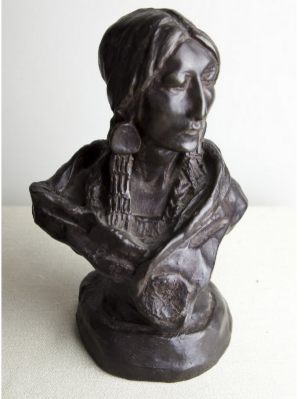
Charles Marion Russell, Piegan Woman, c. 1902
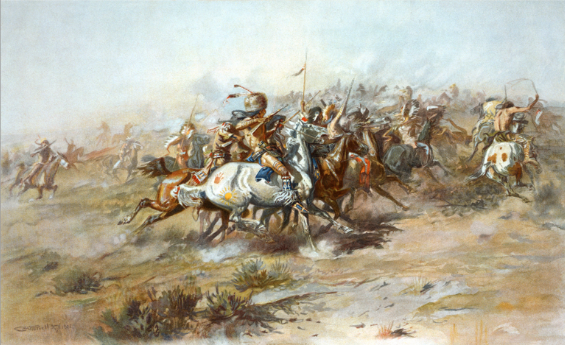
Charles Marian Russell, The Custer Fight, 1903
Charles Marion Russell (March 19, 1864 – October 24, 1926) is well known as a “cowboy artist” who painted cowboys, Native Americans, and landscapes set in the western United States. While he was prolific in creating more than 2000 paintings, he is less known for his sculptures in bronze. He was an advocate for Native Americans and was instrumental in legislating on their behalf, particularly in terms of land management.
Growing up in Missouri, he was fascinated with stories of westward expansion, ultimately moving to Montana to work on a sheep ranch at only sixteen years of age. Montana became his home for the remainder of his life, where he lived with the Blood Indians (a branch of the Blackfeet nation) and became immersed in their culture. As such, Russell’s works are deeply personal and demonstrate his admiration for Native Americans as he sought to portray them with dignity and honor.
In this bronze bust, Piegan Woman, Russell depicts an emotive moment. Sculpted on a three-quarter turn, her downward glance and side profile are deeply contemplative. She represents the Blackfeet nation, a population that dominated the North American Great Plains during the nineteenth century. Russell’s attention to her hair and to her traditional headdress is notable, as ermine tails, feathers, and bunches of grass were worn during important ceremonies that symbolize status and connection to nature.
Painted a quarter of a century after the Battle of the Little Bighorn, Russell’s appreciation of women can be seen as timely and significant in his painting The Custer Fight. In this large work hefeatures three women in a legendary encounter: Moving Robe Woman, Rain -In-The -Face, and Buffalo Calf Road Woman. The participation of Native American women in combat during that period has been recently explored in scholarship, and as such, has been found to reflect deeply personal motives, such as the pursuit of revenge for the death of a relative slain in battle. While it is true that very few women chose the way of the warrior as a life-long pursuit, alternative gender roles appear to have been culturally sanctioned in the Piegan Blackfeet Nations of Alberta and Montana. Such women gravitated, often at an early age, to traditionally male activities, most notably hunting and warfare.
Similar to The Custer Fight and rendered shortly beforehand in 1902, Piegan Women may be a backward glance reflecting the present-day sorrow of continual encroachment on the nation by European Americans and Canadians who forced the Blackfeet to cede their lands and move to smaller reservations.


