
Look Again – Week 12
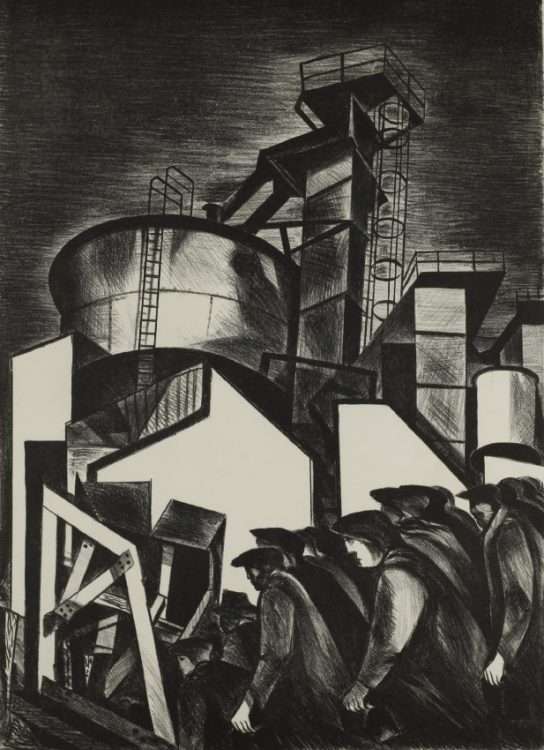
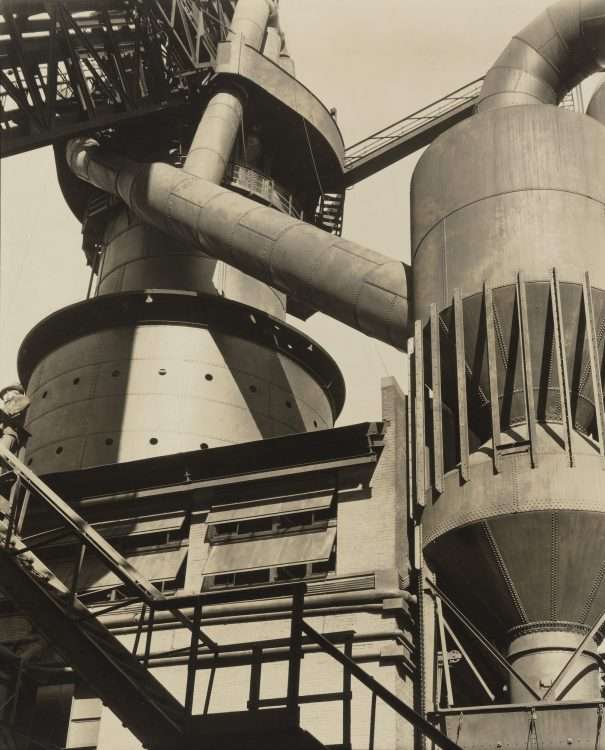
Joseph Vogel’s Another Day & Charles Sheeler’s Crisscrossed Conveyors, River Rouge Plant, Ford Motor Company
Perspective is the art of drawing solid objects on a two-dimensional surface so as to give the right impression of their height, width, depth, and position in relation to each other when viewed from a particular point. But the word is also be used to define a particular attitude toward or way of regarding something, such as a point of view. In comparing a print by Joseph Vogel and a photograph by Charles Sheeler we can “Look Again” at these two works through both perspectives.
Artists responded to the new urban environment in the early years of the twentieth century by adapting certain formal features of a new style called Futurism, a movement in art that glorified the machine age. Futurism was an artistic and social movement that originated in Italy and to a lesser extent in other countries, in the early 20th century. It emphasized dynamism, speed, technology, youth, violence, and objects such as the car, the airplane, and the industrial city. Artists repeated forms dynamized by color, light, or shadow and by abolishing conventional perspective.
Take for instance the print Another Day by Austrian artist Joseph Vogel (1911-1995). The perpendicular motion created by Vogel is markedly demonstrated by crowd of men that are moving toward an open door. The men are staggered in height which creates a sense of speed in their movement, made more notable by their arms that hang perpendicular to the horizontality of their collective bodies. The huddle leans forward, their hunched torsos in line with their right hands that appear to be swinging ahead. The chutes, silos, elevators and storage towers are “crisscrossed” creating the dynamism popular in Futuristic art paintings.
Vogel was a lithographer and muralist who was born in Austria. His family lived in Poland before settling in New York in the 1920s, where he studied at the Art Students League. He worked for the Graphic Arts Division of the Federal Art Project, a New Deal initiative that put artists to work during the Great Depression. The Division’s New York workshop fostered a vibrant community of leftist printmakers.
Vogel traveled to Spain where he had moved for a brief period to support the Popular Front during the Spanish Civil War. Before returning to New York, Vogel saw Picasso’s mural Guernica (1937), and its blend of abstract style and political subject matter made a profound impact.
Contrasting Vogel’s Another Day with Charles Sheeler’s Crisscrossed Conveyors, River Rouge Plant, Ford Motor Company photographed just a few years earlier, it is clear they both create an active emission of motion and energy. However, in Sheeler’s depictions of factories there is a noticeable absence of workers.
Conversely, Vogel adds a huddled group of men, which changes the narrative of industry as an economic balm or glorified reward. Rather, he portrays the apathy and monotony typical of factory life.
Charles Sheeler’s photograph celebrates industrial progress. Born in 1883 in Doylestown Pennsylvania,(July 16, 1883 – May 7, 1965) he was known for his Precisionist paintings, commercial photography, and avant-garde films. Recognized as one of the early adopters of modernism in American art, he was sarcastically dubbed the “Raphael of the Fords,” for his paintings and photographs of Ford’s automobile empire. While he did occasionally betray some ambivalence toward American industry, Sheeler nevertheless created the most reverential images of factories in all media. In this photograph, slightly off-center, crossed diagonal conveyor belts are anchored by the staccato verticals of the smokestacks and the viewer’s gaze is focused upward, as if in religious contemplation. “It may be true,” Sheeler wrote, “that our factories are our substitute for religious expression.”9 Judging from the number of times Crisscrossed Conveyors was reproduced, it clearly struck a chord with business leaders looking to exalt the image of industry.
Vogel’s print embodies drudgery in its title and apathy in the bent over shoulders of the faceless workers who seem to trudge forward for yet “another day.” Similar to Sheeler’s photograph, conveyors tower over the men underneath a darkened sky which may mean the men are also working at night. “Shift- working” became normative, as production needed to enlist a large labor force.
While both artists use various forms of cropping, shadow, and perspective, it is Vogel who adds the human component that resonated the truths and realities of factory life, while Sheeler’s work purged the art of emotion. Blending dynamism, efficiency, and impersonal power, the factories and his skyscraper images completed in the 1920s and 1930s masked the human element that propelled a nation forward.


Leave a Reply
You must be logged in to post a comment.