
Look Again! – Week 13
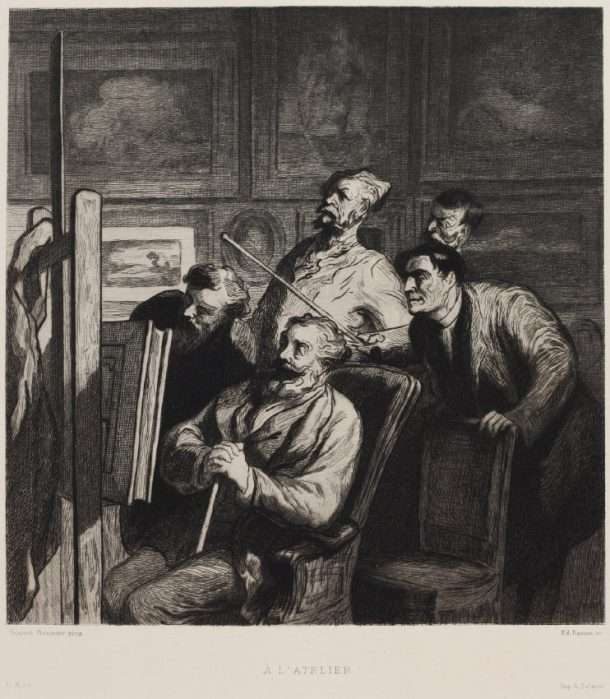
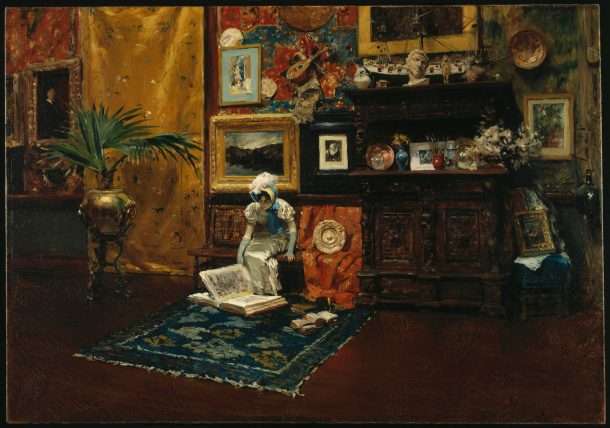
Honore Daumier’s A L’ Atelier & William Merritt Chase’s Studio Interior
Honoré-Victorin Daumier (1808 –1879) was a French painter, sculptor, and printmaker whose many works offer commentary on social and political life in France. He earned a living producing caricatures and cartoons in newspapers and periodicals. As a working class liberal, he satirized the established elite as well as the monarchy, This print is a caricature of pompous artists/critics deciding what is acceptable in the academic milieu. Five men, most likely a mix of artists, critics, and dealers analyze the art world and the cultural and economic significance of the work at hand. Surrounded by other “questionable” paintings hanging in the French salon style around them, they ponder the painting before them with great attention. A gentleman placed to the rear of the composition circles around with a pointing rod in hand to emphasize a point. Standing aside, leaning forward and tilting to see closely, Daumier has varied the men’s postures to animate the drawing and to add more levity. The back-and-forth rhythm represents the image as a farce, as the activity has no meaning. Known for his connections to popular French politics, and radical social views, Daumier pokes fun at the pretentiousness of artists and critics and the political divisions of the time. The French text augments the satirical sketch drawing on the absurdity of the French king. It states, Go ahead and enter the sea without fear, Mr. Potard, you can see there’s no danger since I’m already in it! – Mrs. Potard, if you had read Buffon, you would be less reckless… you would know that the ocean is home to two of the most terrifying animals in nature… sharks and lobsters! Daumier, a proponent of Realism, preferred to paint and illustrate images that were truthful and poignant to his socio-economic agenda during the period of the Revolution in 1830 until the fall of the Second French Empire in 1870.
Conversely artists’ studios in America resembled the very ones Daumier chose to criticize. Greatly influenced by French Impressionism, American artist William Merritt Chase, brought its influence to the New York art scene, not only in his paintings but in his studios as illustrated in Studio Interior. When arriving back in America after completing his first European tour, he settled in New York City and quickly set about finding a studio that would fulfil his wish of occupying “the finest studio in New York.” Inspired by the great studios he had visited on his tours of Europe; Chase transformed his New York atelier into a magnificent artist’s retreat that allowed New York to rival Paris and other European locations as a world center for artistic sophistication. He settled on a space in the Tenth Street Studio Building and went about decorating it with the collectibles he had amassed while in Europe.
The taste for large highly decorated studios, studio-homes, and private galleries during the last quarter of the nineteenth century in Europe and America may have been influenced by European royal collections that were open to the public. The artists’ studios were spaces for eccentricities, cabinets of curiosities, and galleries all in one. Because selling of art from the artist’s studios was a prime factor, the décor of the studios became part of the marketing strategy.Many were well-outfitted with northern and southern exposures, and some with skylights. Discarded furniture, props, inspirational objects, travel souvenirs, and the artist’s own paintings were typical of a utilitarian setting. Later engravings, easels, plaster casts, and Victorian furnishings were in place. Individual artists had items such as snow shoes, seal skins, and walrus teeth from various travels. Artists like Chase created elaborate settings to display their large pictures sometimes complete with black crepe draping, dramatic lighting, views from balconies and massive hand carved black walnut frames to encase the paintings. Thus, artists were models of success and each invited patrons to their studios and studio-homes for dinners and exhibitions that were testaments to wealth and good fortune.
This painting shows part of Chase’s large space inside the Tenth Street Studio in Greenwich Village, New York City to which he moved in 1878. Designed by Richard Morris Hunt and completed in 1857, this was the first building in America specifically meant to house artists’ studios. Chase’s was one of the largest and most elaborate studios in the building, and he furnished it with his collections of art, furniture, and decorative objects from all over the world. Studio Interior depicts an opulent interior, richly adorned with an array of framed artworks and decorative objects. The composition centers on an elegantly dressed woman seated in front of an emerald jeweled carpet perusing a book (a catalogue?) of various artworks for sale. Behind her a golden-framed painting captures the viewer’s eye among a backdrop of various other framed pieces and objets d’art decorating the walls. The studio space, imbued with light, reflects the artist’s masterful play with shadows and textures, lending a sense of depth and realism. Subtle dashes of red, green, and gold add vibrancy to the predominantly muted palette, elegantly balanced to convey a serene yet intellectually stimulating environment.
Similar to Daumier’s drawing, Chase’s large outer room served as a showroom for his and other artists latest work, and an exhibition space for critics, artists and the public to visit. Wealthy visitors would then admire the room’s artistic elements and at the same time be inspired to admire his paintings during parties, Sunday open houses, and theatrical performances that were scheduled on site.
Stay tuned for more on ateliers in America as we introduce Kindred Spirits: Frederic Church and the Tenth Street Studio, a year long exhibition that will be featured in the Baer Gallery this upcoming Spring in celebration of Frederic Church’s 200th birthday. The museum is part of a consortium of fifty national and international museums who are reconsidering Church’s art, life, and belief in new and different ways.


Leave a Reply
You must be logged in to post a comment.