
Look Again — Week 14
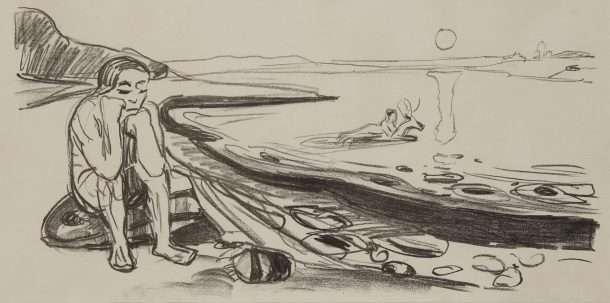
David and Susan Werner Collection. (In WCMFA’ s Scandinavian Exhibition)
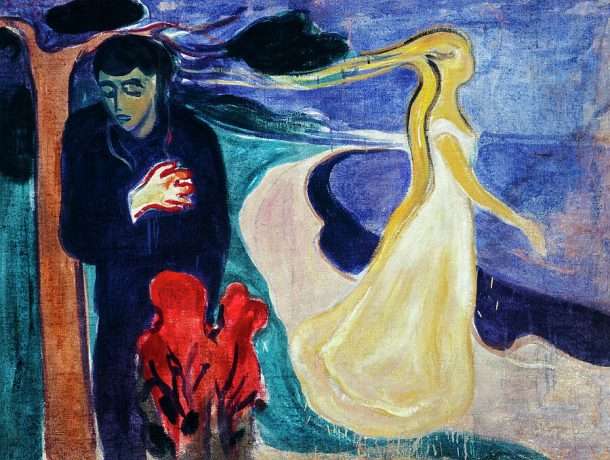
Edvard Munch (1863–1944), was a Norwegian painter and printmaker whose intensely evocative treatment of psychological themes built upon some of the main tenets of late nineteenth century Symbolism. Born on December 12, 1863, in Løten, Norway, Munch grew up in a household periodically afflicted by life’s darker sides, including the early loss of his mother and sister to tuberculosis, which deeply affected his upbringing and later work. Munch himself endured a life of madness, sickness and alcoholism. His father and grandfather suffered from depression, another sister from schizophrenia and a brother from pneumonia.
The psychologically and emotionally debilitating effects of the Industrial Revolution, combined with recent scientific discoveries such as sound waves, electrical currents, x-rays, and germs, led to an understanding that many real things were intangible. Artists were then charged with creative license to how they might convey sound, touch, feelings, thoughts and dreams. To portray images that could refer to something imaginary or impalpable, Symbolist artists like Edvard Munch, did not have a single style, but instead experimented with a wide variety of techniques which included painting, lithography, etching, and woodcut. However different Symbolist works appear, they all deviate from perceptual reality in terms of color and form, or by including fantastical objects or beings, such as those encountered in dreams and fairytales. Interestingly Munch was also a writer, and used variations of the same images, juggling them in various media combinations to symbolize different or similar human conditions.
Comparing Munch’s painting The Separation,1896, and his lithographic portfolio Omega’s Flight 1908, is a case in point. In Omega’s Flight, Munch composed a bitter fairy tale about the protagonists Alpha and Omega. Their characters refer to Adam and Eve- the first and the last—who live on a paradisiacal island. Alpha shares her love with several animals on the island, including the deer on whose back she rides, while Omega sits by the shore in a posture of melancholy, separated from her and her love. At the end of the tale, Omega kills Alpha, only to be torn apart by Alpha’s monstrous progeny.
In The Separation,1896, Munch once again illustrates a man’s sorrow at parting from his love. As in other cases, the picture consists of two components similar to Omega’s Flight, the objective in the foreground, in which the protagonist may be either frontal and active, as here, or in profile and contemplative, and the subjective in the background, the image of the past in his or her mind’s eye. Unrequited love is demonstrated in both works by the man who hunches forward with his head down and eyes half closed. Both the lithograph and the painting seem to suggest that the man is trapped in a melancholic present. Moreover, the women appear in the background separated from the men by land, and sea. In Separation the woman’s long hair floats across into his world and caresses his head, tying him to his vision, allowing him no escape from his memory. In both works a repeated coiled shoreline separate the man from the woman he loves. The curvilinear lines of the girl’s flowing dress merge with the coastal barrier as she moves toward a future without the man. So too, the woman in Omega’s Flight floats out to sea with her antlered “buck” (most likely a personification for male prowess). Color is illusionistic in Separation as Munch has challenged norms with green painted faces, violet seas, and a bloodied hand. The shores’ shadowy lines are chaotic scribbles drawn throughout the lithograph that create a barrier and decrease the probability of the couple’s reconciliation. Most scholars agree that images such as these are reflections of Munch’s volatile? relationship with Tulla Larsen which ended poorly. After their breakup Munch’s mental health continued to decline. Munch’s art became a reflection of his inner turmoil, with themes of fear, death, and isolation becoming increasingly prominent regardless of the media he chose to depict his anxieties.


