
Look Again! – Week 3
Week 3 – November 3, 2025: Helen Frankenthaler’s Barcelona & First Stone
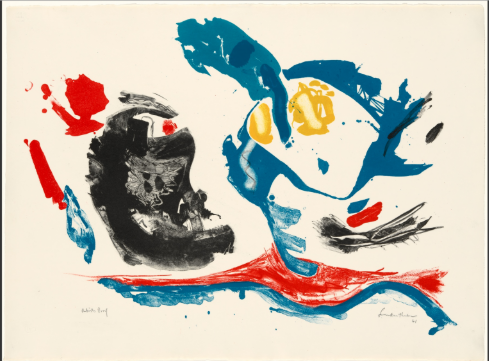
Helen Frankenthaler, Barcelona, 1977
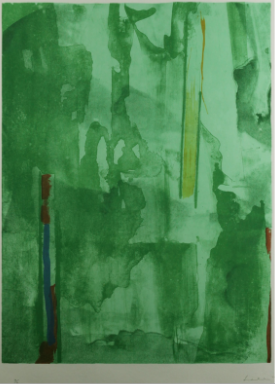
Helen Frankenthaler, First Stone, 1969
Helen Frankenthaler (1928–2011) wasn’t just a painter – she was a printmaking revolutionary who transformed the medium with her daring approach to color and technique. Her “soak-stain” method, which she first developed in painting unprimed canvases, would become her signature, that emerged from her painting practice. But it also became a pivotal moment in the art of printmaking, challenging every conventional understanding of how prints could be created. It is worth noting that Frankenthaler saw prints first and foremost as a distinct medium. Apart from lithography, Frankenthaler also worked with woodcut and woodblock prints, screen prints, and mixed media prints.
In this richly layered work, Barcelona, Frankenthaler created this lithograph from nine colors in a workshop at Ediciones Poligrafa, SA (Barcelona, Spain). Paying homage to the evening bustle of this modern city, Frankenthaler titled the work, accordingly, honoring the location that provided the ideas,materials, and place. In painting on unprimed canvases, Frankenthaler would pour paint and encouraged it to flow where it would when she applied it. Coining the “soak-stain” technique, she built on the tradition of Jackson Pollock’s Action Painting, a process by which he would lay a large canvas on the floor and drip paint on it in order to record his activity. Frankenthaler poured turpentine-thinned paint onto canvas, producing luminous color washes that appeared to merge with the canvas and deny any hint of three-dimensional illusionism. Similar to her soak-stain canvases the colors ooze and bleed, vying for room and space, creating movement, depth, and transparency in prints such as Barcelona. She experimented with shades of green paint that contrasted with the primary colors of blue, red, and yellow. As such, she is often referred to as a Color Field artist, exploring color and its movement and unpredictable relationships.
Born in New York in 1928, Frankenthaler emerged during the Abstract Expressionist movement that was redefining artistic expression. She was introduced early in her career to major artists such as Jackson Pollock and Franz Kline and was married to artist Robert Motherwell, yet she developed her own style. Unlike her male contemporaries, who dominated the scene, Frankenthaler approached printmaking in innovative and nontraditional ways. Her prints weren’t just reproductions; they were living, breathing artistic statements that questioned the very definition of the medium.
Barcelona is an example of how she transfigured traditional methods in lithography. Unlike previous artists who used hard, defined lines, precise carving, and controlled color application, no marks register as cut or etched in prints such as Barcelona. Integral to her processes, she did not treat the printing plate or stone as a rigid surface, and she understood how different papers absorbed pigments. She was also aware of the chemical interactions between different printing inks, and as such, she created soft color fields that seemed to float across the paper. In works such as Barcelona, Frankenthaler might saturate her lithographic stones directly – allowing color pigments to merge in unprecedented ways. In this way, she reimagined how color would interact with the surface materials.
Traveling the world, Frankenthaler visited different workshops and spent countless hours editing proofs with unnerving precision and rejecting studios’ practices. In a different way “action painting” had been understood, she used her nails, her elbow, even her face, to manipulate the different printing materials. Her work has been the subject of several retrospective exhibitions, including a 1989 retrospective at the Museum of Modern Art in New York City, and been exhibited worldwide since the 1950s. In 2001, she was awarded the National Medal of Arts. Frankenthaler had a home and studio in Darien, Connecticut.


