
Is It Real? Fake? Or a Genuine Artistic Learning Method?
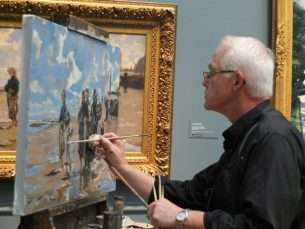 Artist Christopher Madden definitely knows the differences between forging and counterfeiting, and copying art. He’s an expert in all three. An internationally trained classical artist, he retired as the Lead Engraver after 35 years with the Bureau of Engraving and Printing in Washington, D.C., becoming one of the few Banknote Picture Engravers in the United States. ) One of his engravings is the official portrait of President Barack Obama.)
These days Madden is spending his time at the Washington County Museum of Fine Arts (WCMFA) in Hagerstown, MD, where he is engaged in a special project designed to highlight the traditional role of copying in the development and growth of fine artists. Eight members of the regional group of which he’s president, Master Art Copyists, are spending six months, through May 11, copying various works hanging on the museum’s walls. While not affiliated nor endorsed by the National Gallery of Art (NGA), MAC members have all been authorized as NGA copyists.
On Wednesday, February 5, from 5:30-6:30 p.m., Madden will present a talk at the WCMFA entitled, “Standing on the Shoulders of Giants: The History and Processes of the Art Copyist”, in which he’ll highlight the role of copying in the history of fine art; explore the history, philosophies, methods and approaches to studying/copying great paintings and painters on-site; and explain the value of these opportunities for the artist. He’ll also talk about the differences between copying and forging art and counterfeiting currency.
“As a banknote engraver, I spent decades doing a sort of copying, that is to say interpreting a given tonal model — whether a president, landscape or postage stamp — into very precise intaglio engravings for printing,” Madden said. “That world, however, was very limited in creativity for me as my expectation was to create instruments of value for security and not for aesthetic expression. When I began copying at the National Gallery of Art, I was both awed and intimidated by the challenge. It seemed surreal to actually carry and use oil paint right next to these priceless works of art.”
Madden says he never lost the feelings of awe, but he did manage to overcome the intimidation he initially felt.
“I have found my facility as a painter has grown exponentially due to the studies I have explored as a copyist. Historically, copying was a valued tool for any serious painter to build skills. Many famous art luminaries of the past spent many hours copying the masters of their times. It has been my goal to take the lessons I learn from standing on the shoulders of giants’ to bring a level of execution and realization to my work that also represents a voice in the world we live in today. I believe this sort of holding a mirror up to our world is an important responsibility for an artist.”


