
Look Again – Week 4
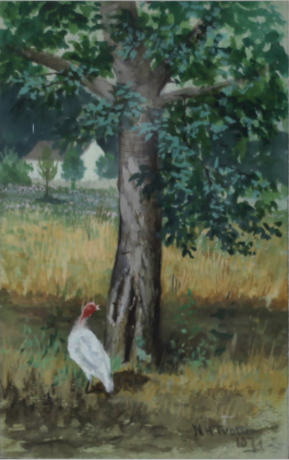
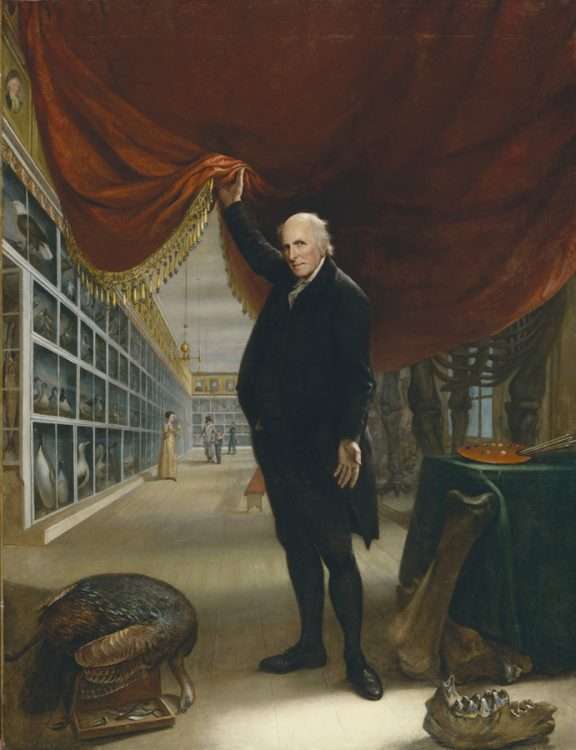
Week 4 November 17, 2025: Newbold Hough Trotter’s Turkey and Tree & Charles Willson Peale’s The Artist in his Museum
Newbold Hough Trotter, (American, 1827–1898), Turkey and Tree, 1877,Tempera on paper
Charles Willson Peale, The Artist in his Museum, 1822, Oil on canvas
Newbold H. Trotter was born in Philadelphia in 1827. It was not until 1867 that he turned to painting as a full-time occupation. He had been in business in Philadelphia and served in the Germantown Home Guards during the Civil War. He exhibited at The Pennsylvania Academy between 1858 and 1887, The National Academy of Design in New York between 1871 and 1886, and the Boston Athenaeum between 1859 and 1867. He was also a member of the Art Club of Philadelphia and the Artists’ Fund Society of Philadelphia.
Trotter painted mainly landscapes and animal subjects. In Turkey and Tree, Trotter depicts a lone female albino turkey standing to the left of what may be a beech tree. As the focal point in Trotter’s painting, her small white body draws the viewers eyes from the static tree, the garden, and the farm-like building in the background, into an animated narrative. Trotter’s turkey is less a portrait than a narrative account, noting the hen’s open beak and side-turned head.
Wild turkeys were domesticated as early as the seventeenth century in North America, and this white hen may have wandered from her flock. She seems to be calling out into the distance outside the scene. Their vocabulary consists of twenty-eight distinct calls. Each sound has a general meaning and can be used for different situations. Male turkeys are notorious for their iconic gobble, which, unlike other calls, is given with a fixed intensity. Turkeys, whether male or female, typically move and forage in flocks up to two miles in one day, depending on habitat and distance to food and water sources. One can imagine Trotter’s hen may be selecting this hardwood tree as her nighttime roost, as turkeys generally use different sites and move from tree to tree. While turkeys raised by humans are typically white, white wild turkeys are rare and do exist in the wild.
Trotter’s hen is a rare bird indeed. Her feathers are characterized by visible short broken brushstrokes and pure unmixed color Trotter’s emphasis on light and inclusion of movement was a crucial element of human perception, a notable technique used by American Impressionists. Like the radicals of his time, he violated the rules of academic painting. He painted realistic scenes of everyday life in natural settings often outdoors, attempting to capture a moment as experienced, typically painting landscapes and animals. Compared with the Charles Wilson Peale’s detailed and minute attention to the taxidermic rendering of his turkey in An Artist’s Studio, Trotter eschewed those principles of academic training in his hen and instead chosen short broken brushstrokes and pure white paint -clearly bringing the lost bird to the foreground of his painting rather than blending her into a camouflaged position.
Turkeys clearly had one fan among the Founders of America, Benjamin Franklin, even though it appears that the birds weren’t close to challenging the eagle as the nation’s proud patriotic symbol. While we may never know whether Trotter’s humble hen is foraging, calling her flock, or trying to find her way back home, she has evolved into a national symbol of quietude, gratitude, and bounty.


