
Look Again! – Week 6
Week 6 – December 15, 2025: Milton Clark Avery’s Man by Choppy Sea & Sally Michel Avery’s Cat Lady
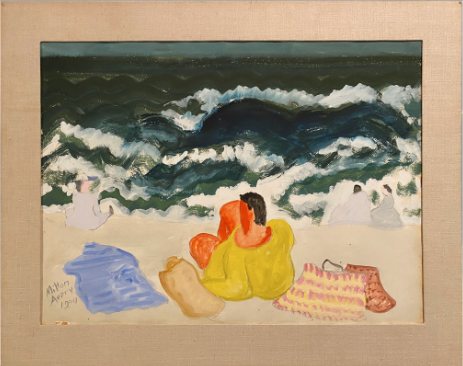
Milton Clark Avery, Man by Choppy Sea, 1944
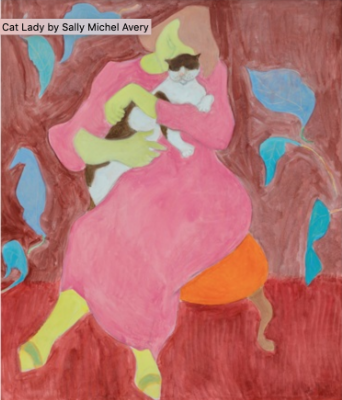
Sally Michel Avery, Cat Lady, 1978
While the works of Milton Clark Avery (March 7, 1885 – January 3, 1965) can be viewed as clearly representational paintings, they are seminal to American abstract painting. Avery was often thought of as an American Matisse because of his colorful and innovative landscape paintings that focused on the relationship between colors. His modernist, poetic, bold, and creative use of drawing and color set him apart from more conventional works of his era. Like other modern artists, Avery’s work embodied the philosophical turn over in which the academic traditions of the past were thrown aside in a spirit of experimentation. He experimented with new ways of seeing and with fresh ideas about the nature of materials and functions of art.
Born in 1885 into a working-class family in Connecticut he taught himself to paint. His interest in art led him to attend classes at the Connecticut League of Art Students in Hartford. Like most young artists, he worked odd jobs to support himself in his early years. His greatest supporter was his wife, Sally Michel (1902-2003), and artist in her own right, who eventually managed his career and gallery exhibitions. She was considered a colleague, travelled with him, and actively participated in developing the artistic language of expressionism and figural abstraction through discussions with friends and fellow artists. Together they shared a studio, and their painting style became known as the “Avery Style.” Their works, charged with glowing color, flat planes, and simplified forms, portrayed the importance of family and embodied empathy with the hardships of the Great Depression.
Considered an avant-garde artist, the couple’s social circle revolved around the Abstract Expressionist painters such as Mark Rothko and Adolph Gottlieb. Yet unlike their friends, Sally’s and Milton’s works carried a genuine lightness and joie de vivre in a period of artistic collaborations that leaned into existentialism. Despite the Wall Street Crash of 1929, wars, and a decade of economic depression, as well as having to bury his pride in working on New Deal commissions, many of Milton Avery’s works depict the outdoors, his pets, the scenery of his early days, and family holidays.
Beach Scene favors broader, flat, thinly painted areas of close-valued darker hues with occasional pops of accent color and exemplifies his signature style. In the foreground, the large figure painted in warm, saturated tones of dazzling orange and intense yellow is gazing toward a lone figure on the left side of the composition. This tranquil moment is in sharp juxtaposition with the dark green turbulence of roaring waves rushing toward the shore that will soon submerge the two figures on the right. The flat planes of gray color in their dress mirror the white foam of the breaking surf, rendering them more or less invisible. The narrow strip of horizon painted in a lighter hue delineates the sky from the sea and remarkability draws the eye to the center of the composition. Here, the viewer may enter the scene from behind and join the central figure in staying awhile. Perhaps Beach Scene embodies an interiority and is indicative of Avery’s ability to find peace in a turbulent and changing world. It was not until 1952, and at the age of 67, that he received his first full-scale retrospective museum exhibition. Opening at the Baltimore Museum of Art, this large display of 85 works travelled in a reduced form to further venues in Washington DC, Hartford, and Boston.


