
Look Again! – Week 7
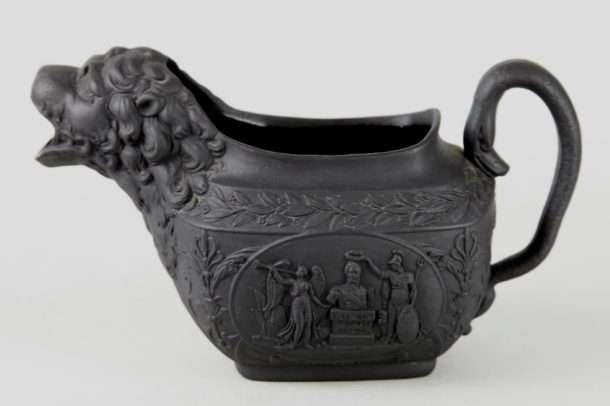
Week 7 – January 5, 2026: Josiah Wedgwood’s Teapot & Antislavery Medallion
Serving and drinking tea at home became enormously popular in America after the mid-18th century. Like the tea itself, many of the implements, dishes, and pots used were imported from China or influenced by forms brought to America from Asia. Wedgwood achieved the dark black color of basaltware “by adding manganese and carr, a slurry rich mixture-with-iron oxide obtained from coal mines to the clay body.” In this alchemical innovation, Wedgwood imitated the early pottery of Etruria (then generally described as Etruscan, an ancient civilization in northern Italy) that was fashioned from volcanic rock. When Josiah Wedgwood perfected his recipe for basaltware in 1768, he boldly claimed that “Black is sterling and will last forever.” While Wedgwood’s designs for a new American consumer market were classically unpretentious and essentially straightforward, the goal was to keep his customers on par with their British “betters.” Marketing to a hungry audience that was heir to the Age of Enlightenment and neoclassical design, Wedgwood created ceramics for a burgeoning society that wished to embody the ideological principles of reason, science, individual conscience, and religious tolerance. In entrepreneurial fashion Wedgwood understood that a new nation like America forged on egalitarian principles of Greco-Roman republicanism, was eager to express an eternal identity of ideal and Platonic universal truths.
Remembered as the “Father of English Potters,” Josiah Wedgwood was the youngest of twelve children born in Burslem, Staffordshire, in the heart of the English potteries. Apprenticing with his brother for four years he founded his own ceramic business in 1759, where his focus was on designing rather than crafting pottery. Pursuing experiments with new wares and glazes, his innovative products gained popularity, and by 1763, Wedgwood was filling orders for kings, queens, and nobles in ornate items such as jasper ware, basalt, caneware, agate, majolica, as well as utilitarian items, in what he referred to as “useful wares.”
Wedgwood employed many notable artists including George Stubbs, the famed artist best-known for his careful study (and depiction) of horses to design bas-reliefs, often imitating classical Greek motifs. Wedgwood made an industry out of selling imitations of Etruscan vases, as well as teapots and bowls, termed‘usables,” that were heir to classically inspired themes or ornament. Wedgewood was a radical and astute businessman who saw America’s potential as a capital of finance and freedom in the pre- and post-revolutionary war.
Thus, Americans were an important new consumer group who continued to desire earthenware designs that were both beautiful and functional and that advocated cleanliness. In the pursuit of refinement, the new nation sought out objects to maintain certain protocols, such as the tea ritual. However, there was not a single pottery manufacturer to fashion teapots, cups, plates, and saucers that could match the quality and aesthetic of Wedgwood’s designs. Wedgwood wrote: “I think you judge very properly about the time and way of ushering in the Grecian vases, and I hope we shall meet the approbation of our friends in this new improvement.”
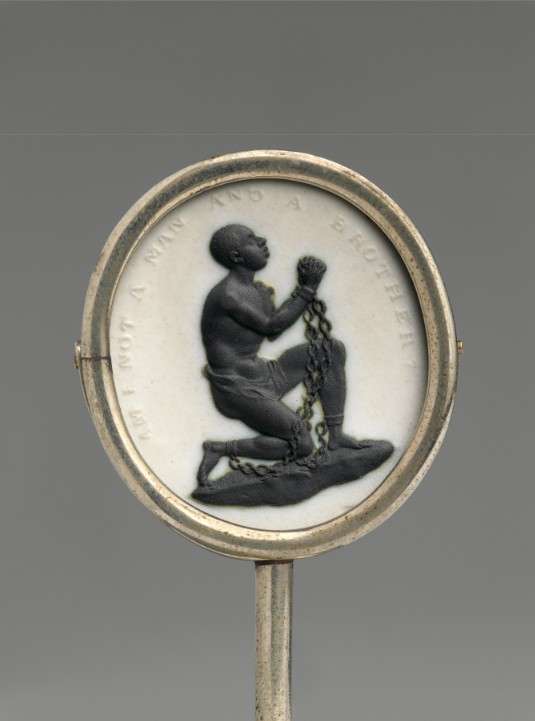
From 1787 until his death in 1795, Wedgwood actively participated in the abolition-of-slavery cause through his friendship with Thomas Bentley. Thus, he created the Slave Medallion which brought public attention to abolition. The white Jasper and Black Basalt medallion featured a kneeling African man shackled in chains and asked the evocative question: “Am I not a man and a brother?” Wedgwood mass-produced these cameos with a black basalt figure against a white background and donated many for wide distribution, even sending them to Benjamin Franklin in 1788, who was then president of the Abolition Society in America. Franklin believed that the medallion, as he told Wedgwood in a letter dated May 15, 1787, “may have an Effect equal to that of the best written Pamphlet, in procuring Favour to those oppressed People.”


